A Zimbabwean national, Tatenda Banga, has pleaded guilty in a Seattle court to two federal felonies following his illegal border crossings from Canada into Washington State. Acting U.S. Attorney Teal Luthy Miller announced the plea, noting that Banga, 30, was detected twice in 2024 by surveillance cameras near Hozomeen in the North Cascades. He admitted to being an unlawful alien in possession of firearms and possessing controlled substances with intent to distribute. Sentencing is set for June 12, 2025, before U.S. District Judge Jamal N. Whitehead.
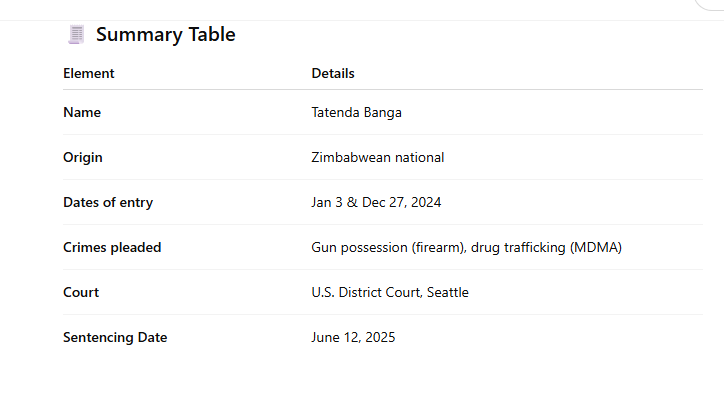
The plea agreement reveals that on January 3, 2024, U.S. Border Patrol technology captured an image of an armed individual entering the United States near Ross Lake. The person, later identified as Banga, was seen crossing the border with a longarm shotgun and subsequently defacing another camera nearby. Despite efforts by Border Patrol and National Park Service personnel to locate him, Banga evaded capture but left behind a loaded Winchester shotgun traced back to Montreal.
On December 27, 2024, further cross-border activity was reported when a National Park Service canoe was found near Ross Dam containing a machete and food wrappers. Surveillance images from RCMP showed someone with a headlamp and backpack moving towards the border.
Banga was later spotted walking along Highway 20 by Border Patrol agents who noted his resemblance to the individual seen in RCMP footage. During an immigration inspection, he failed to provide documents proving legal entry into the U.S., leading to his custody where agents discovered scales, gelatin capsules, and approximately 1.4 pounds of MDMA.
Fingerprints from the previously recovered shotgun were matched to Banga after his arrest. Additionally, information retrieved from his phone linked him to the firearm. Banga acknowledged illegally entering the U.S. while armed with the shotgun.
Unlawful possession of a firearm by an alien carries a potential sentence of up to 15 years in prison, while possession of controlled substances with intent to distribute can result in up to 20 years imprisonment. Judge Whitehead will consider sentencing guidelines and other factors before delivering a sentence.
The investigation involved collaboration between several agencies including U.S. Border Patrol Blaine Sector Anti-Smuggling Unit, National Park Service, and ICE Homeland Security Investigations (HSI). The prosecution is led by Assistant United States Attorney Dane A. Westermeyer alongside Special Assistant United States Attorney Katherine Collins.
Info News
Real Estate & Investment Opportunities
Building wealth through property is one of the most reliable strategies today. Explore the best real estate investment opportunities, compare property management services, and learn how rental income strategies can generate passive cash flow. Whether you’re interested in commercial real estate, home equity loans, or mortgage rates, making smart property decisions can significantly increase your long-term financial returns.
Investors are also leveraging real estate crowdfunding platforms, REIT investments, and property flipping strategies to maximize profits. Understanding market trends and working with experienced professionals can help you secure high-value assets and grow your portfolio efficiently.
Best Credit Cards for Bad Credit in 2026
If your credit score is low, finding the right credit card can feel difficult. The good news is that there are still credit cards designed to help people with bad credit rebuild their financial profile while keeping spending manageable.
This topic has strong search intent because people searching for it usually want an answer right away. They are not casually browsing. They are trying to find a card they can actually qualify for, which makes this a strong topic for both SEO and monetization.
The first thing to understand is the difference between secured and unsecured cards. A secured card usually requires a refundable deposit, while an unsecured card may not. For many people with bad credit, a secured card is the easiest place to start because approval is often based on the deposit and basic income information rather than a high score.
When comparing cards, look at annual fees, interest rates, deposit requirements, and whether the card reports to the major credit bureaus. Reporting matters because the goal is not just to get a card, but to use it in a way that can help improve your credit over time. A card that does not report properly may not help you build a stronger credit history.
You should also look for cards with simple approval requirements and a path to upgrade later. Some issuers review accounts after several months of responsible use and may allow you to move to a better card. That can be useful if your goal is to rebuild credit and eventually qualify for stronger rewards or lower rates.
Using the card responsibly is just as important as choosing the right one. Make small purchases, keep your balance low, and pay on time every month. These habits can help improve your credit profile over time and make future borrowing easier.
It is also wise to avoid cards with unnecessary fees or confusing terms. When your credit is already damaged, the last thing you want is a product that makes the situation worse. The best card should help you move forward, not trap you in more debt.
The best credit card for bad credit is the one that is easy to qualify for, reports to the credit bureaus, and helps you rebuild your financial standing with responsible use.


