Sunday, May 31

Hell Commander Announces To Run Against Themba Mliswa For Norton MP In 2023 Elections

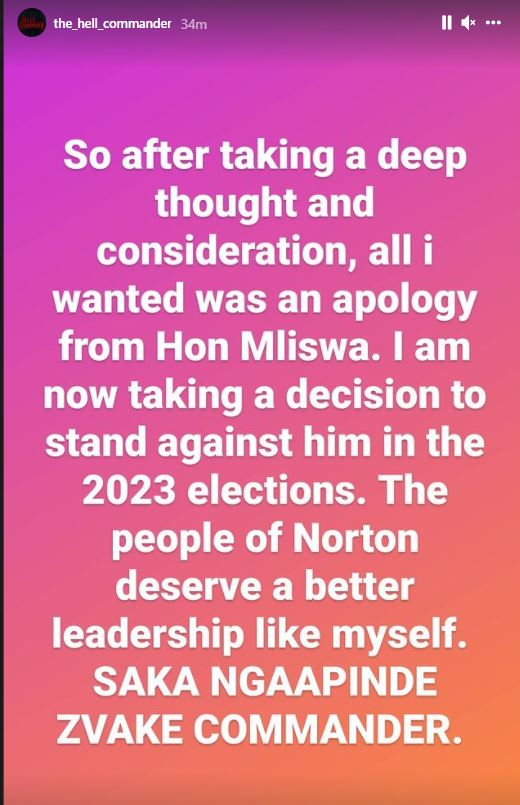
South African based millionare businessman The Hell Commander  has just announced his plans to run against Themba Mliswa in 2023 to be the MP for Norton.

The Hell Commander is not happy with Themba Mliswa and the work he has done for Norton. Themba  Mliswa attacked Jah Prayzah for sleeping with married women and the Hell Commander called him out on not fixing roads in Norton and developing the area. Below is the post from The Hell Commander.

Related Story

Hell Commander Invites Temba Mliswa for a Fight

Few days ago, Mliswa took to social media to warn Jah Prayzah about his habit of sleeping around with married and engaged women.

However, thousands reacted to his tweets with some slamming Jah Prayzah while others urging Mliswa to mind his own business.
Hell Commander is part of the group of Zimbabweans who criticised Mliswa following his tweet about Jah Prayzah.

“Dear Honourable Temba Mliswa, the potholes in your district needs ur attention. Your people need transport, clean water and a whole service delivery system. Mukadzi we muntu anozviziva kuti ane murume and haisi problem yenyu iyoyo. So if you don’t mind please go back to work,” posted Trevor Mbizvo on Instagram.

“Can you imagine all this energy over sh*t being channeled towards nation building, important issues affecting every sadza eater? I just saw a post of a whole MP attacking Jah Prayzah over a woman, like seriously. Nyika yakanokorwa tsoka iyi,” he added.

In a video he released today, Hell Commander said he wants to deal will Temba Mliswa one on one.

  • Share:

Info News

The Rise of Remote Work: How Digital Jobs Are Reshaping the Future of Employment

Remote work has transformed from a temporary trend into a permanent part of the global economy. Millions of employees across the United States, Canada, the United Kingdom, Australia, Nigeria, South Africa, Kenya, Ghana, and Zimbabwe are now working from home or operating fully online businesses. Advances in internet technology, cloud computing, video conferencing platforms, and digital collaboration tools have made it possible for companies to operate efficiently without traditional office spaces.

rnrn

Before the global shift toward remote work, many businesses believed employees needed to be physically present in offices to remain productive. However, companies quickly discovered that remote teams could often perform just as effectively while reducing operational expenses. Businesses are now saving money on office rent, utilities, transportation allowances, and infrastructure costs. Employees also benefit from flexible schedules, reduced commuting stress, and improved work-life balance.

rnrn

The technology industry has been one of the biggest drivers of remote employment growth. Software developers, cybersecurity analysts, digital marketers, virtual assistants, content creators, and customer support professionals are among the many workers thriving in online environments. Freelancing platforms and remote job marketplaces are connecting companies with skilled workers from around the world, creating opportunities for talented individuals regardless of location.

rnrn

In Africa, remote work is creating new economic opportunities for young professionals. Many entrepreneurs and freelancers in Nigeria, Kenya, Ghana, Zimbabwe, and South Africa are working with international clients while earning income in foreign currencies. This shift is helping reduce unemployment challenges while supporting digital entrepreneurship and online education initiatives.

rnrn

Despite its advantages, remote work also presents challenges. Employees sometimes struggle with isolation, distractions at home, and difficulties separating work life from personal life. Businesses must also address cybersecurity risks, communication barriers, and employee engagement concerns. Many organizations are now adopting hybrid work models that combine office collaboration with remote flexibility.

rnrn

Experts believe remote work will continue growing as internet access improves and digital transformation expands globally. Businesses that adapt successfully to flexible work environments are expected to remain competitive in the modern economy. Workers with digital skills, strong communication abilities, and experience using online collaboration tools are likely to remain in high demand for years to come.

rn

Employment Class Action Lawsuit: Wage, Overtime, and Worker Rights

employment class action lawsuit, wage and hour class action, overtime lawsuit, unpaid wages lawyer, employee class action attorney, worker rights lawsuit

rnrn

Employment Class Action Lawsuit: Wage, Overtime, and Worker Rights

rnrn

When one employee is underpaid, it may be a mistake. When hundreds or thousands of workers are underpaid in the same way, it may become an employment class action lawsuit.

rnrn

Employment class actions can help workers challenge company-wide policies that allegedly violate wage, hour, discrimination, or labor laws.

rnrn

These cases may involve unpaid overtime, off-the-clock work, misclassification, meal breaks, unpaid commissions, background check violations, or discriminatory practices.

rnrn

What Is an Employment Class Action?

rnrn

An employment class action is a lawsuit filed on behalf of a group of workers with similar legal claims against an employer.

rnrn

The workers may have been affected by the same:

rnrn

Pay policy
rnTimekeeping system
rnJob classification
rnBreak policy
rnCommission plan
rnBackground check process
rnHiring practice
rnScheduling practice
rnWorkplace rule

rnrn

In federal court, class actions must satisfy Rule 23 requirements, including common legal or factual questions and adequate representation.

rnrn

Common Employment Class Action Claims

rnrn

Unpaid Overtime

rnrn

Employees may claim they worked more than 40 hours per week but were not properly paid overtime.

rnrn

Off-the-Clock Work

rnrn

Workers may claim they were required to work before clocking in, after clocking out, during unpaid breaks, or while responding to messages outside scheduled hours.

rnrn

Misclassification

rnrn

Some workers may claim they were wrongly classified as independent contractors or exempt employees.

rnrn

Meal and Rest Break Violations

rnrn

State laws may require certain meal or rest breaks. Violations can affect many workers.

rnrn

Unpaid Commissions or Bonuses

rnrn

Sales employees may bring claims over unpaid commissions, incentive pay, or bonus plans.

rnrn

Discrimination Class Actions

rnrn

Workers may challenge company-wide discrimination in hiring, pay, promotion, or termination.

rnrn

What Evidence Helps Workers?

rnrn

Useful evidence may include:

rnrn

Pay stubs
rnTime records
rnSchedules
rnEmails
rnText messages
rnCompany policies
rnEmployee handbook
rnJob descriptions
rnCommission agreements
rnClock-in records
rnWitness statements
rnPerformance records

rnrn

Workers should save documents when legally allowed and avoid deleting important communications.

rnrn

Can You Be Fired for Joining a Lawsuit?

rnrn

Retaliation laws may protect employees who assert workplace rights. However, retaliation issues can be complicated.

rnrn

If you fear retaliation, speak with an employment lawyer before taking action.

rnrn

Class Action vs. Collective Action

rnrn

Wage cases may involve class actions, collective actions, or both, depending on the law.

rnrn

For example, some federal wage claims use a collective action process where workers may need to opt in.

rnrn

The exact procedure depends on the claim and jurisdiction.

rnrn

What Can Workers Recover?

rnrn

Employment settlements may include:

rnrn

Unpaid wages
rnOvertime pay
rnPenalties
rnInterest
rnPolicy changes
rnAttorney fees
rnInjunctive relief
rnRecordkeeping improvements

rnrn

The amount depends on the case, law, number of workers, and damages.

rnrn

What Employers Usually Argue

rnrn

Employers may argue:

rnrn

Workers were properly paid
rnEmployees were exempt
rnTime records are accurate
rnClaims are too individualized
rnClass treatment is improper
rnPolicies were lawful
rnDamages are overstated

rnrn

Employment class actions can be strongly contested.

rnrn

When to Contact an Employment Class Action Lawyer

rnrn

You may want legal help if:

rnrn

Many workers have the same pay problem
rnOvertime was denied
rnEmployees worked off the clock
rnBreaks were missed due to company policy
rnWorkers were wrongly treated as contractors
rnPay stubs do not match hours worked
rnA company-wide policy seems unfair or illegal

rnrn

Final Thoughts

rnrn

Employment class action lawsuits can help workers challenge widespread workplace violations.

rnrn

If your employer’s pay or workplace policy affected many employees the same way, legal options may exist.

rnrn

Save records, avoid guessing, and speak with a qualified employment attorney.

rn