Saturday, September 19

Mai TT Confirms Comedian Gringo Has Passed Away

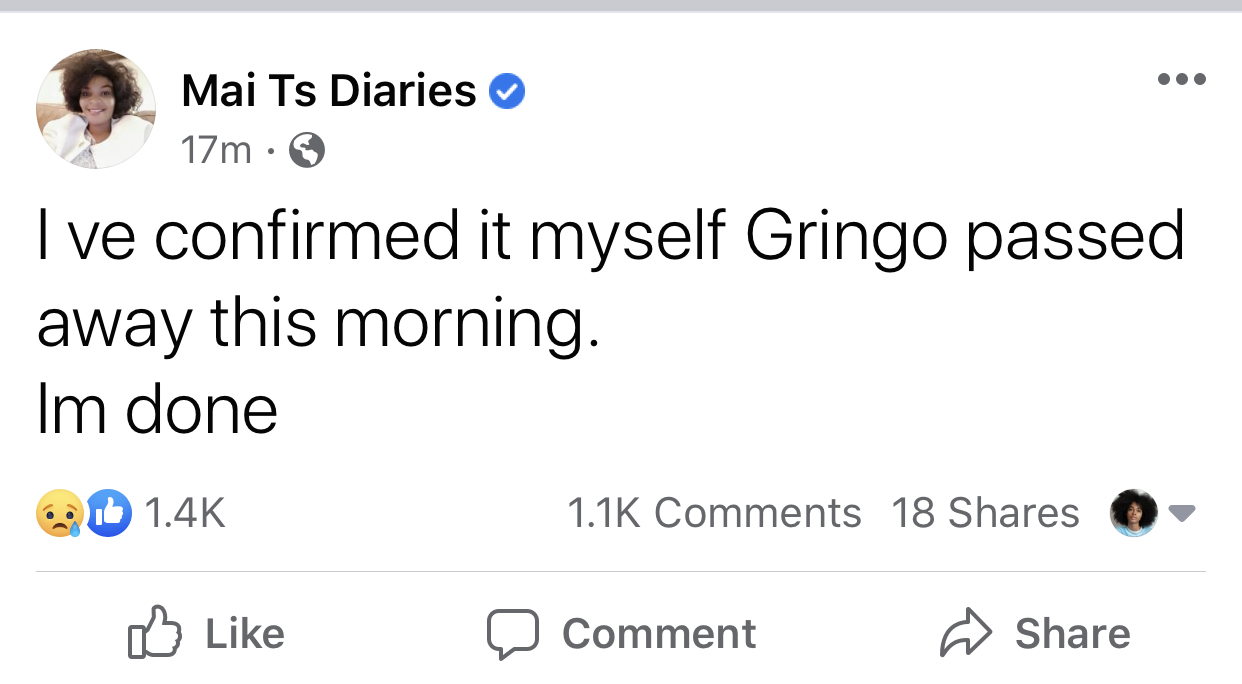
Mai TT just posted on her Facebook that Gringo has passed away see her post below,

I ve confirmed it myself Gringo passed away this morning.
Im done

Related Story 

Gringo Is Alive But Still In Hospital

Local comedian and actor Lazarus Boora (Gringo) is alive and recovering at Westview Medical Centre in Zimre Park, Harare where he is hospitalised.


This was confirmed by Gringo’s doctor, Dr Johannes Marisa yesterday after social media was awash with messages claiming that the popular actor had died. “I’m surprised by the reports on social media. Gringo is still recovering at our hospital and I’ve just attended to him,” Dr Marisa said yesterday morning.

In an interview on Saturday, the doctor revealed that they conducted tests on Gringo and were awaiting some of the results. “We’ve conducted all the necessary tests and check-ups that where need to be done. Unfortunately, because of medical ethics and council, I can’t divulge the results and what Gringo is suffering from. For now, we request you to go with what his wife has told you,” he said.

The actor’s wife Netsai Meki, said she was shocked by the fake news of her husband’s death. She also confirmed that he is alive before asking for people to respect Gringo and desist from taking pictures of him on the hospital bed each time they visit him.

“I just fed him this afternoon. I’d like to thank everyone who’s concerned over Gringo’s health and I ask those who visit not to take photographs of him on his hospital bed. They are causing unnecessary alarm and despondency as it sends a wrong signal.


“They can visit, but for now, no pictures,” she said.


According to family members, Gringo is battling intestine obstruction and has a sitting discomfort, backache, hearing and talking difficulties.

Last year the actor underwent surgery for an appendix rupture before he relocated to his rural home in Rusape. He recently returned to Harare where has been staying with his wife and three children.

Local comedian and actor Lazarus Boora (Gringo) is alive and recovering at Westview Medical Centre in Zimre Park, Harare where he is hospitalised.

This was confirmed by Gringo’s doctor, Dr Johannes Marisa yesterday after social media was awash with messages claiming that the popular actor had died. “I’m surprised by the reports on social media. Gringo is still recovering at our hospital and I’ve just attended to him,” Dr Marisa said yesterday morning.

In an interview on Saturday, the doctor revealed that they conducted tests on Gringo and were awaiting some of the results. “We’ve conducted all the necessary tests and check-ups that where need to be done. Unfortunately, because of medical ethics and council, I can’t divulge the results and what Gringo is suffering from. For now, we request you to go with what his wife has told you,” he said.

The actor’s wife Netsai Meki, said she was shocked by the fake news of her husband’s death. She also confirmed that he is alive before asking for people to respect Gringo and desist from taking pictures of him on the hospital bed each time they visit him.

“I just fed him this afternoon. I’d like to thank everyone who’s concerned over Gringo’s health and I ask those who visit not to take photographs of him on his hospital bed. They are causing unnecessary alarm and despondency as it sends a wrong signal.

“They can visit, but for now, no pictures,” she said.

According to family members, Gringo is battling intestine obstruction and has a sitting discomfort, backache, hearing and talking difficulties.

Last year the actor underwent surgery for an appendix rupture before he relocated to his rural home in Rusape. He recently returned to Harare where has been staying with his wife and three children

  • Share:

Info News

Cyber Insurance for Small Business: Coverage Guide

Cyber insurance has moved from a nice-to-have policy to a serious risk management tool for small businesses. Even companies with fewer than 50 employees depend on email, cloud software, online banking, remote access, customer databases, websites, point-of-sale systems, and mobile devices. A single ransomware infection, stolen password, or fraudulent wire request can stop operations and create expensive response costs.

Cyber insurance is designed to help with certain costs after a covered cyber incident. It is not a replacement for good security, but it can support response and recovery when controls fail. The exact coverage depends on the insurer, policy form, endorsements, exclusions, and security requirements.

First-party coverage applies to the business's own losses. This may include breach response, forensic investigation, data restoration, business interruption, ransomware response, crisis communications, legal consultation, and customer notification. If a business cannot operate because systems are locked or cloud access is disrupted, business interruption coverage may help replace covered lost income during the downtime period.

Third-party coverage applies when other people or organizations claim your business caused harm. This may include legal defense, settlements, regulatory investigations, privacy claims, media liability, or contractual claims after a data breach. Businesses that store customer records, health information, financial data, payment information, or confidential client files should pay close attention to this area.

Business email compromise is one of the most important topics to ask about. Many losses now involve fraudulent emails, fake invoices, payroll diversion, vendor impersonation, or wire transfer scams. Some cyber policies cover social engineering or funds transfer fraud only if a special endorsement is added. Others exclude it or provide a lower sublimit. Ask specifically: If an employee is tricked into sending money to a criminal, is that covered?

Ransomware coverage also varies. Some policies may help with negotiation, legal guidance, recovery support, and covered payments where legally allowed. However, insurers may require security controls before offering ransomware coverage. These controls can include multifactor authentication, endpoint detection, backups, patch management, email filtering, employee training, and privileged access restrictions.

Cyber insurance applications have become more detailed. Insurers may ask whether multifactor authentication is used for email, remote access, administrator accounts, and cloud systems. They may ask about backups, encryption, endpoint protection, firewalls, vulnerability scanning, incident response plans, vendor access, and security training. Answer honestly. Inaccurate answers can create problems during a claim.

Not every cyber event is covered. Common exclusions may involve prior known incidents, war or nation-state activity, bodily injury, infrastructure failure, intentional acts, failure to maintain required controls, unencrypted devices, or losses outside policy definitions. Because exclusions can be broad, review the policy with someone who understands cyber risk.

Small businesses should also ask about the insurer's response team. A strong cyber policy is not just a reimbursement document. It should connect the business with breach coaches, forensic firms, ransomware response vendors, public relations support, and legal resources. In an incident, speed matters. Knowing who to call can reduce confusion.

Cyber insurance pricing depends on revenue, industry, data type, employee count, security controls, claims history, remote access, vendor exposure, and coverage limits. Health care, financial services, legal firms, schools, professional services, and e-commerce businesses may face higher scrutiny because they handle sensitive data or payments.

Before buying a policy, map your most important systems. Include email, accounting, online banking, payroll, website hosting, customer records, cloud drives, point-of-sale, remote access, and backup systems. Then compare policy limits against realistic incident costs. A small ransomware event can involve forensics, legal review, overtime, lost revenue, customer notice, and system rebuilds.

Cyber insurance works best when paired with basic security. Use multifactor authentication, strong password management, least privilege access, regular patching, offline or immutable backups, endpoint protection, DNS filtering, email security, vendor reviews, and employee phishing training. Document these controls because insurers may request proof.

For small businesses, cyber insurance is not about fear. It is about resilience. The right policy can help a company recover faster, protect customers, and survive an incident that might otherwise be financially damaging.

Divorce Lawyer Near Me: How to Choose the Right Attorney for Your Case

divorce lawyer near me, divorce attorney, family law attorney, best divorce lawyer, divorce law firm, contested divorce lawyer, family court lawyer

rnrn

Divorce Lawyer Near Me: How to Choose the Right Attorney

rnrn

Divorce is not just a legal process. It can affect your home, children, money, retirement, business, credit, emotions, and future.

rnrn

That is why many people search for a divorce lawyer near me when they realize the marriage may be ending.

rnrn

A divorce lawyer can help you understand your rights, protect your interests, prepare documents, negotiate a settlement, and represent you in court if needed.

rnrn

The American Bar Association’s Family Law Section covers legal issues connected to divorce, custody, child support, domestic violence, marital property, military law, and other family relationship matters.

rnrn

What Does a Divorce Lawyer Do?

rnrn

A divorce lawyer helps people handle the legal issues involved in ending a marriage.

rnrn

Common issues include:

rnrn

Child custody
rnParenting time
rnChild support
rnSpousal support
rnProperty division
rnDebt division
rnRetirement accounts
rnBusiness ownership
rnReal estate
rnProtective orders
rnTemporary orders
rnMediation
rnCourt hearings
rnSettlement agreements

rnrn

A lawyer’s job is not only to file paperwork. A good divorce attorney helps you make smart decisions during a stressful time.

rnrn

When Should You Hire a Divorce Lawyer?

rnrn

You may want to speak with a divorce lawyer if:

rnrn

You have children
rnYou own a home
rnYou or your spouse owns a business
rnThere are retirement accounts
rnThere is significant debt
rnYou are worried about hidden assets
rnYour spouse already hired a lawyer
rnThere are abuse or safety concerns
rnYou disagree about custody
rnYou need spousal support
rnYou expect a contested divorce
rnYou do not understand your rights

rnrn

Even if you hope for an uncontested divorce, legal advice can help you avoid costly mistakes.

rnrn

Contested vs. Uncontested Divorce

rnrn

Uncontested Divorce

rnrn

An uncontested divorce means both spouses agree on the major terms. This may include property division, custody, support, and debt.

rnrn

Uncontested cases are often faster and less expensive, but the agreement still needs to be prepared correctly.

rnrn

Contested Divorce

rnrn

A contested divorce means the spouses disagree on one or more major issues.

rnrn

Common disputes include:

rnrn

Who gets the house
rnHow custody is divided
rnHow much child support is owed
rnWhether alimony should be paid
rnHow retirement is divided
rnWho pays marital debt
rnWhether assets were hidden

rnrn

A contested divorce may require negotiation, mediation, hearings, or trial.

rnrn

How to Choose the Best Divorce Lawyer

rnrn

1. Look for Family Law Experience

rnrn

Divorce law is different from criminal law, personal injury, or business law.

rnrn

Ask:

rnrn

How much of your practice is family law?
rnHave you handled cases like mine?
rnDo you handle custody disputes?
rnDo you handle high-asset divorce?
rnDo you handle business valuation issues?
rnDo you go to trial if needed?

rnrn

2. Choose the Right Style

rnrn

Some divorce lawyers are aggressive litigators. Others focus on settlement and mediation.

rnrn

You need the right style for your situation.

rnrn

If your spouse is cooperative, a settlement-focused lawyer may help reduce conflict. If your spouse is hiding assets or using intimidation, you may need a stronger litigation approach.

rnrn

3. Ask About Communication

rnrn

Divorce cases can take time. You need a lawyer who communicates clearly.

rnrn

Ask:

rnrn

Who will handle my case?
rnHow often will I receive updates?
rnHow do I contact your office?
rnHow quickly do you respond?
rnWill I speak with you or mostly with staff?

rnrn

4. Understand the Fees

rnrn

Divorce lawyers often charge hourly fees and require a retainer. Some simple cases may qualify for flat fees.

rnrn

Ask:

rnrn

What is your hourly rate?
rnWhat is the retainer?
rnHow are court costs billed?
rnDo you charge for emails and phone calls?
rnWhat happens if the retainer runs out?
rnCan you estimate total cost?

rnrn

What to Bring to a Divorce Consultation

rnrn

Bring as much information as possible, including:

rnrn

Marriage date
rnSeparation date
rnChildren’s information
rnIncome records
rnTax returns
rnBank statements
rnRetirement accounts
rnMortgage documents
rnCredit card debt
rnCar loans
rnBusiness records
rnPrenuptial agreement
rnCourt papers, if already filed

rnrn

The more complete your documents, the better the attorney can evaluate your case.

rnrn

Red Flags to Avoid

rnrn

Be careful if a lawyer:

rnrn

Guarantees you will get everything
rnEncourages unnecessary fighting
rnDoes not explain fees
rnRefuses to discuss risks
rnDoes not listen
rnPromises exact custody results
rnPressures you to file immediately without review
rnHas little family law experience

rnrn

No ethical lawyer can guarantee the exact outcome of a divorce.

rnrn

Final Thoughts

rnrn

Choosing the right divorce lawyer can shape your financial future and your family life.

rnrn

Look for experience, communication, strategy, honesty, and a fee structure you understand.

rnrn

A good divorce lawyer should help you protect your rights without making an already painful situation harder than necessary.

rn