A Zimbabwean court has upheld a traditional court’s ruling that the body of former President Robert Mugabe should be exhumed and reburied at a national shrine in the capital. HARARE, Zimbabwe (AP) — A Zimbabwean court Friday upheld a traditional court’s ruling that the body of former President Robert Mugabe should be exhumed and reburied at a national shrine in the capital.
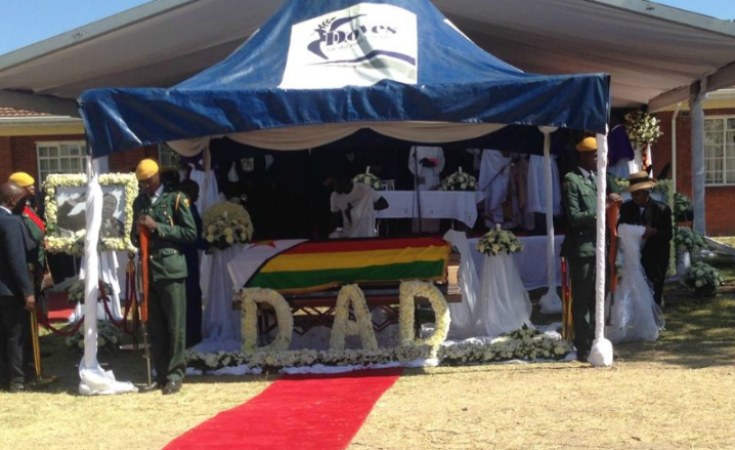
The Chinhoyi Magistrates Court rejected an appeal by Mugabe’s children that the traditional court's ruling should be ignored, Mugabe family lawyer Fungai Chimwamurombe said. The three children had challenged the exhumation ruling made by the traditional chief of the Zvimba area, Mugabe’s rural home. Mugabe's current grave in the Zvimba area is part of the chief’s jurisdiction.
Chief Stanley Wurayayi Mhondoro ruled in May that Mugabe’s widow, Grace, had violated traditional customs by organizing Mugabe’s burial in the family home compound. He also fined Grace five cows and a goat for not carrying out the burial properly.
Mugabe’s three children, who did not attend the chief’s court hearing, appealed the ruling in June.
Mugabe's body is unlikely to be moved quickly as the case is likely to remain in the courts for a long time, said the lawyer.
“The children have a right to appeal. It is a ruling that ought to be challenged,” said Chimwamurombe.
It's the latest twist in the controversy regarding the burial of one of Africa’s longest serving and controversial rulers. Mugabe led a 1970s bush war to end the white-minority rule of the country, then known as Rhodesia. He came to power in 1980 and the early years of his rule were marked by improvements in health, education and pay for the country's black majority but soon he faced accusations of ethnic killings in the west of the country. By the year 2000 Mugabe had become a more repressive leader.
He died aged 95 in Sept. 2019 and was buried in a private ceremony in his rural home’s courtyard after a weeks-long dispute with the government over his resting place.
President Emmerson Mnangagwa’s government wanted Mugabe’s burial to be a public event at the hilltop National Heroes Acre, reserved mainly for top officials and military leaders of the ruling party, ZANU-PF.
The Mugabe family refused, claiming that Mugabe had left orders for a private burial because he was bitter at being deposed in a 2017 coup by Mnangagwa and the military that had anchored his rule for decades.
The government has denied it has had a hand in the latest saga, saying this is a matter between a traditional chief and his subjects.
The second anniversary of Mugabe’s death last week went largely unnoticed in Zimbabwe.
Info News
How a Truck Accident Lawyer Maximizes Your Injury Claim Settlement
Truck accident lawyers specialize in handling high-value injury claims involving commercial vehicles. Because trucking companies carry substantial insurance policies, these cases often involve large settlements. However, insurers also deploy aggressive defense tactics to reduce liability. An experienced attorney understands these strategies and counters them effectively, ensuring that victims receive fair compensation for injuries and damages.
A strong claim requires detailed evidence, including accident reports, expert testimony, and medical documentation. Truck collision attorneys also analyze black box data and driver compliance with safety regulations. By building a comprehensive case, they increase the likelihood of securing compensation that covers long-term medical care, rehabilitation, and financial losses.
Space Exploration and the Search for Life Beyond Earth
Space exploration has fascinated humanity for generations, inspiring scientific discoveries and technological innovation. Governments and private companies are investing billions of dollars into missions designed to explore the Moon, Mars, and distant regions of the universe. Advances in rocket technology, satellite systems, and astronomy are expanding human understanding of space and the possibility of life beyond Earth.
One major goal of modern space programs is establishing long-term human presence on other planets. Space agencies such as NASA and private companies are developing technologies that could allow astronauts to live and work on Mars in the future. Scientists believe Mars may contain evidence of ancient water systems and potentially microbial life forms that existed billions of years ago.
Space exploration also contributes significantly to technological advancement on Earth. Satellite technology supports communication systems, weather forecasting, navigation services, and disaster management worldwide. Medical research conducted in space environments has also improved healthcare technologies and scientific understanding of human biology.
However, space exploration faces major challenges including high costs, radiation exposure, and the difficulty of sustaining human life in extreme environments. Long-duration missions require advanced life support systems, reliable energy sources, and protection from cosmic radiation.
Despite these challenges, interest in space exploration continues growing globally. Scientists believe future discoveries could provide valuable information about planetary systems, the origins of the universe, and the possibility of extraterrestrial life. Space exploration represents one of humanity’s greatest scientific and technological ambitions.


